Solar-Driven Photocatalytic Seawater Splitting for Green Hydrogen Generation
Scientists have developed a new method to produce green hydrogen directly from seawater using sunlight, offering a promising pathway for clean and sustainable energy.
03 min reading
A new study by a team of scientists from the UK and China has demonstrated how solar-powered direct air capture (DAC) technology could transform carbon removal and sustainable fuel production. By replacing fossil fuel-based heating with solar thermal energy and integrating hydrogen-powered carbon capture, the researchers have developed a system capable of removing one million tonnes of CO₂ annually while converting the captured carbon into sustainable aviation fuel (SAF).
The findings suggest that the innovative process can significantly reduce energy consumption and onsite emissions while producing SAF at a competitive cost. The research also identifies regions with abundant solar resources and low-cost hydrogen as the most promising locations for large-scale deployment, offering valuable insights for governments and industry seeking practical pathways to net-zero emissions.
The paper, published in the journal Nature, proposes a solar-powered direct air capture and utilisation (DACCU) system that captures CO₂ from the atmosphere and converts it directly into SAF. The process combines a hydrogen-fluidised solar calciner with a one-step CO₂-to-jet fuel Fischer–Tropsch conversion pathway. The study demonstrates that replacing natural gas-fired calcination with concentrated solar power (CSP) and using hydrogen instead of oxygen as the fluidising gas can reduce electricity consumption by 63% and onsite CO₂ emissions by 59%.
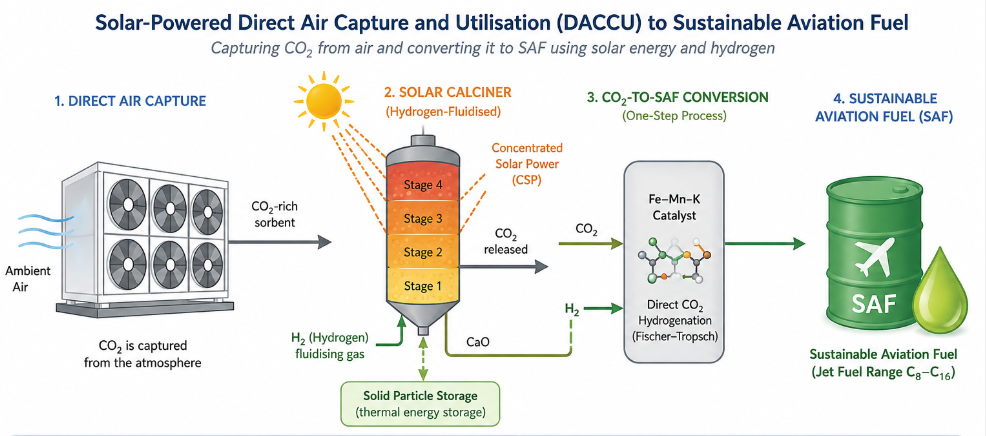
The one-step CO₂-to-SAF conversion process employs an iron–manganese–potassium catalyst for direct CO₂ hydrogenation, achieving 38% CO₂ conversion and 48% selectivity towards jet-fuel-range hydrocarbons (C8–C16). A key advantage of the process is that it eliminates the need for syngas production, CO₂ purification, and separate hydrogen preparation stages.
At the heart of the system is a four-stage hydrogen-fluidised solar calciner operating at 813°C, achieving 95% calcium carbonate (CaCO₃) conversion. The system also incorporates solid-particle thermal energy storage to maintain operation during periods of low solar availability. Designed to capture 1 million tonnes of CO₂ per year, the process could produce approximately 0.12 million tonnes of SAF annually, with a levelized DACCU cost of US$283 per tonne of CO₂ captured.
According to the researchers, the key enablers for commercial deployment include low-cost hydrogen (around US$1/kg), high gas-recycle efficiency, improved solar calciner performance, lower photovoltaic electricity prices, and supportive policy mechanisms such as carbon credits and incentives similar to the US 45Q tax credit.While the results are promising, the authors note that the technology still requires large-scale real-world validation. Further improvements in catalyst performance, reactor design, and heat integration strategies will be needed before widespread commercial deployment can be achieved.
Scientists have developed a new method to produce green hydrogen directly from seawater using sunlight, offering a promising pathway for clean and sustainable energy.
Novel electrochemical device separates electrode environments to accelerate CO₂ uptake while reducing energy consumption, paving the way for scalable carbon capture solutions.
Japanese scientists at the Institute of Science, Meguro in Tokyo have discovered a new type of liquid that could make capturing carbon dioxide from factories and power plants faster and more efficient.