Solar-Driven Photocatalytic Seawater Splitting for Green Hydrogen Generation
Scientists have developed a new method to produce green hydrogen directly from seawater using sunlight, offering a promising pathway for clean and sustainable energy.
07 min reading
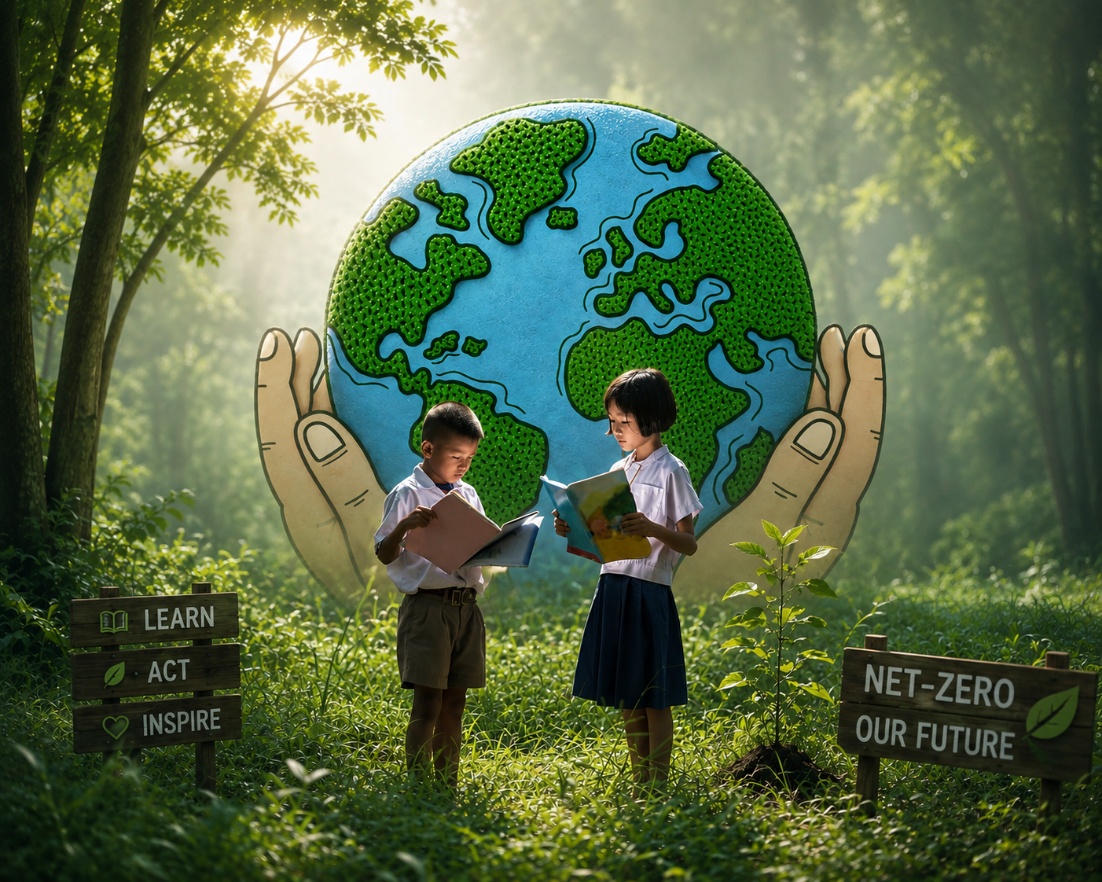
Renewable energy, clean technologies, sustainable infrastructure, and climate innovation are essential, but their success depends on something equally important: people. The future of sustainability will be shaped by individuals who understand complex challenges, think critically, innovate responsibly, and have the skills needed to create solutions.1,2 This is where education becomes a fundamental part of the net-zero journey.2Schools and universities prepare future scientists, engineers, entrepreneurs, policymakers, and community leaders. However, there remains a growing gap between what students learn in classrooms and the environmental, social, and economic realities they will face beyond education.2,3Many learners develop strong academic knowledge but have limited understanding of the interconnected systems that influence climate change, resource availability, biodiversity, social inequality, and sustainable development.2,4
This disconnect highlights a critical challenge: sustainability is often treated as an additional topic rather than a foundation for learning. In many education systems, sustainability appears through occasional projects, environmental campaigns, or individual lessons rather than being embedded throughout the learning experience.2,5 To achieve a sustainable future, this approach must change. Education must evolve from simply transferring knowledge to developing the capabilities needed to navigate an increasingly complex world.2,6
Sustainability is built on three interconnected dimensions: environmental responsibility, social equity, and economic resilience.7 Understanding these connections enables students to recognise that climate challenges cannot be solved in isolation. Environmental decisions influence economies, social systems, public health, and the quality of life for future generations.1,7 For example, a future engineer designing renewable energy systems must understand not only technical principles but also social impacts, resource limitations, and economic feasibility.1,8 Similarly, future business leaders must understand how sustainable practices, circular economy models, and responsible innovation can create long-term value.9
Sustainability education therefore goes beyond teaching environmental facts. It develops the ability to think in systems, analyse complex problems, collaborate across disciplines, and design solutions that consider both present and future needs. These skills are essential for the next generation of innovators who will lead the transition towards net zero.6,8
A sustainable education system should not depend on a single environmental studies lesson or an annual sustainability project. Instead, sustainability should become a principle that connects different areas of learning. A science lesson can explore climate systems, renewable energy, and biodiversity. Economics can examine sustainable business models, responsible consumption, and green growth.9 Engineering and technology education can focus on innovation, efficiency, and resource management. Social sciences can investigate environmental justice, community resilience, and the human impacts of climate change. Language and communication subjects can explore how societies understand and respond to sustainability challenges.1,8
This interdisciplinary approach allows students to see sustainability not as a separate subject, but as a way of understanding the world. Project-based and experiential learning are particularly valuable in this transformation. Students can engage in activities such as measuring their school's carbon footprint, developing local sustainability projects, exploring renewable energy solutions, or working with communities to address environmental challenges. These experiences transform sustainability from an abstract concept into practical action.2,6
Transforming education requires more than changing curriculum documents. Teachers must also be supported with the knowledge, resources, and confidence to deliver sustainability-focused learning. Educators are not simply providers of information; they become facilitators of exploration and critical thinking.6 Sustainability challenges often involve uncertainty, competing priorities, and complex decisions. Students need guidance in evaluating information, considering different perspectives, and developing responsible solutions.Professional development, collaboration between educators, and access to sustainability-focused teaching resources are therefore essential components of successful implementation.2,5
International frameworks, including UNESCO's Education for Sustainable Development approach and Sustainable Development Goal 4.7, recognise the importance of empowering learners with the knowledge, skills, values, and behaviours required to build sustainable societies.2,10
This global movement highlights several important priorities:
These priorities demonstrate that sustainability education is not simply about adding new content. It requires a transformation in how education is designed, delivered, and experienced.2
The University of Exeter provides an example of how sustainability can be integrated across an educational institution rather than being treated as a standalone subject.Through its sustainability education approach, the university connects the United Nations Sustainable Development Goals with different areas of study, encouraging students from diverse disciplines to understand how their future professions can contribute to solving global challenges.11
This approach reflects an important shift in education: sustainability is not only the responsibility of environmental specialists. Engineers, business leaders, policymakers, healthcare professionals, and designers all require sustainability knowledge to make informed decisions and contribute to the net-zero transition.By embedding sustainability across disciplines, education institutions can help develop the skills, creativity, and innovation capacity needed for a more sustainable future.2,8
While the importance of sustainability education is increasingly recognised, significant challenges remain. Many schools face limitations in funding, resources, infrastructure, and teacher training. There is also a risk that sustainability becomes a symbolic commitment rather than a meaningful transformation.Real progress requires long-term investment, collaboration, and commitment from governments, education providers, businesses, and communities. The goal is not to create a generation that only understands climate change. The goal is to develop a generation capable of solving it.1,2,5
The net-zero transition represents one of the greatest challenges and opportunities of our time. It requires new technologies, new business models, new policies, and new ways of thinking. Education is the foundation that enables all of these innovations to emerge. By embedding sustainability throughout learning, we can prepare future generations not only to adapt to a changing world but to actively shape a more resilient, equitable, and sustainable future.2,6,8
The pathway to net zero begins not only in laboratories, industries, and governments, but also in classrooms where the innovators, leaders, and problem-solvers of tomorrow are being prepared.

Aaliya Abdul Rahiman
Head of Media Department
GEMS Winchester School, Dubai
GUnited Arab Emirates
Scientists have developed a new method to produce green hydrogen directly from seawater using sunlight, offering a promising pathway for clean and sustainable energy.
Novel electrochemical device separates electrode environments to accelerate CO₂ uptake while reducing energy consumption, paving the way for scalable carbon capture solutions.
Japanese scientists at the Institute of Science, Meguro in Tokyo have discovered a new type of liquid that could make capturing carbon dioxide from factories and power plants faster and more efficient.