Solar-Driven Photocatalytic Seawater Splitting for Green Hydrogen Generation
Scientists have developed a new method to produce green hydrogen directly from seawater using sunlight, offering a promising pathway for clean and sustainable energy.
03 min reading
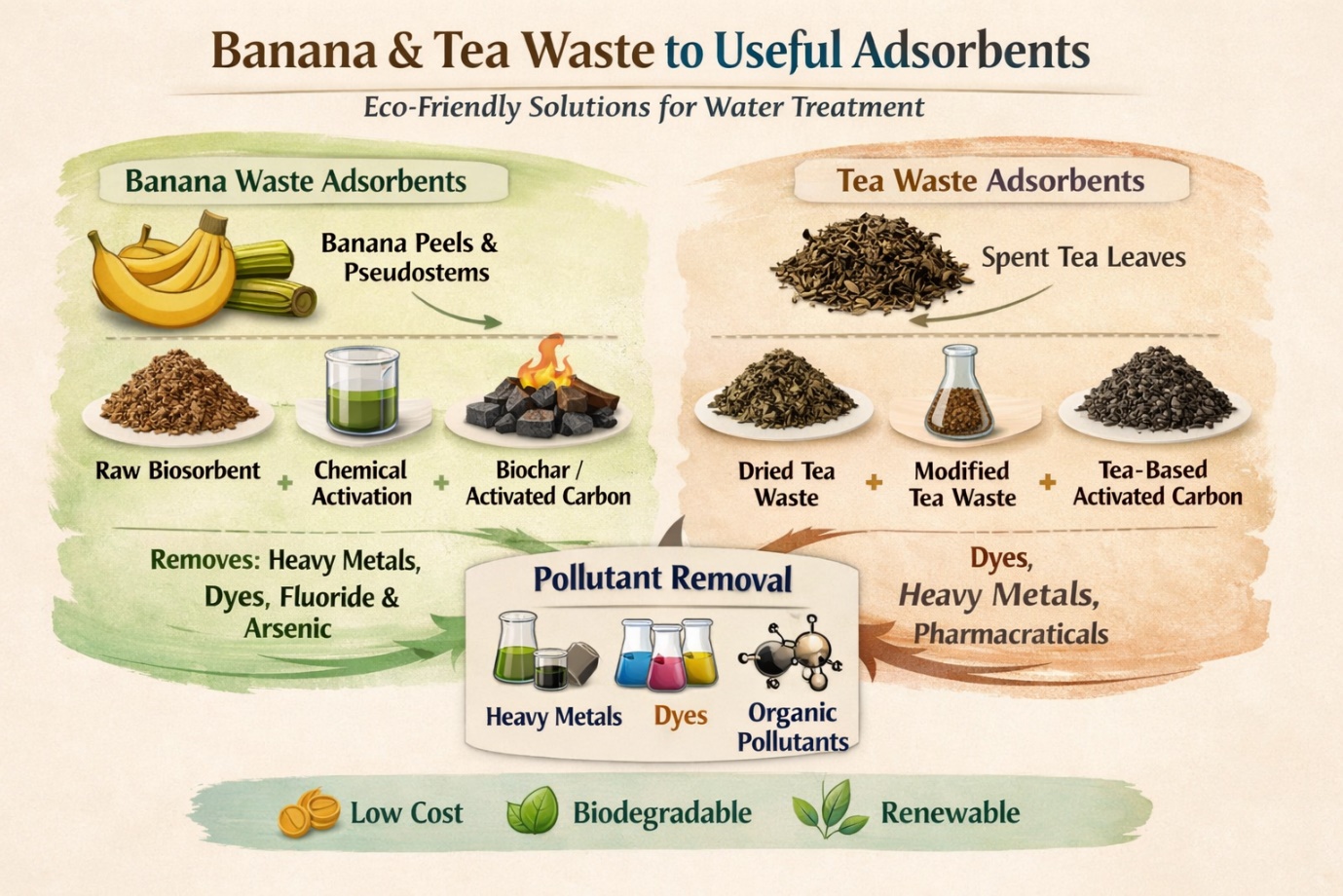
Imagine if the things we throw away every day—banana peels, used tea leaves, food scraps—could help solve one of the world’s most urgent problems: access to clean water.
This inspiring idea is at the heart of the work of Dr. Chirangano Mangwandi , a senior lecturer in Chemical Engineering at Queen’s University Belfast. Through innovative engineering and a deep commitment to sustainability, his research shows how everyday waste can be transformed into powerful tools for protecting the environment and improving lives.
Most of our modern economy follows a simple pattern: take, use, and discard. The circular economy challenges this mindset. It asks a bold question: What if waste was not the end of the story, but the beginning of something new?
Dr. Mangwandi’s work brings this idea to life. By reusing food and agricultural waste to clean polluted water, his research closes the loop—reducing waste, conserving resources, and creating practical solutions for a cleaner planet.
Banana peels make up a large portion of the fruit and are usually thrown away. But Dr. Mangwandi and his team discovered that these discarded skins still have enormous potential.
By carefully processing banana peels, they created small, reusable beads capable of removing harmful pollutants from wastewater, including:
Some of these beads removed over 90% of certain pollutants. Even more exciting, they could be reused—and in some cases performed even better after their first use. This opens the door to affordable, sustainable water treatment technologies made from materials we normally discard.
For readers interested in the scientific details behind this breakthrough, the full research study can be explored here:
Tea is one of the most consumed drinks in the world, and used tea leaves usually end up in landfill. Dr. Mangwandi’s research shows that this humble waste product can be transformed into a highly effective water-cleaning material.
The used tea leaves are treated to create a charcoal-like substance that attracts toxic metals. By adding iron particles, the material becomes magnetic, making it easy to remove from water using a simple magnet after it has captured pollutants.
The results are remarkable: this engineered tea-waste material removes far more pollution than untreated tea waste and can be reused multiple times. It is a powerful example of how smart design can turn common waste into high-impact environmental solutions.
Those who wish to explore the technical research behind this innovation can read more here:
The real strength of this work lies in its practicality. These solutions use materials that are widely available, low-cost, and easy to source—making them especially valuable in regions where access to expensive water treatment technologies is limited.
The impact of this research has already reached beyond the laboratory. In February 2024, it was featured by BBC News, highlighting how used tea leaves could help clean polluted water while reducing waste sent to landfill:
From banana peels to tea leaves, Dr. Mangwandi’s work tells a powerful story: the solutions to global challenges may already be in our hands—or in our bins.
By reimagining waste as a resource and applying thoughtful engineering, this research offers hope for a future where clean water, reduced waste, and sustainable living go hand in hand. It is a clear reminder that innovation doesn’t always require new materials—sometimes, it simply requires a new way of looking at what we already have.
Scientists have developed a new method to produce green hydrogen directly from seawater using sunlight, offering a promising pathway for clean and sustainable energy.
Novel electrochemical device separates electrode environments to accelerate CO₂ uptake while reducing energy consumption, paving the way for scalable carbon capture solutions.
Japanese scientists at the Institute of Science, Meguro in Tokyo have discovered a new type of liquid that could make capturing carbon dioxide from factories and power plants faster and more efficient.